


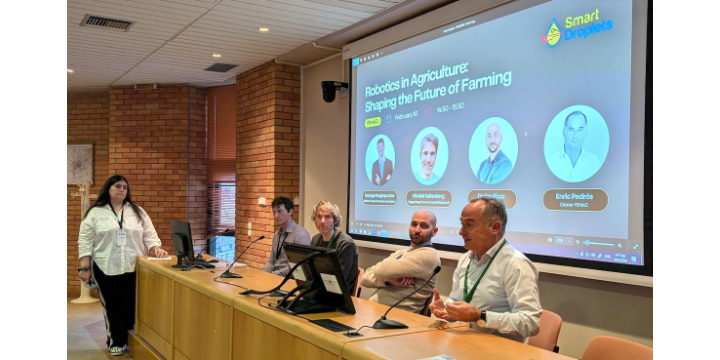
The event started with an internal consortium meeting, where project partners aligned on the final technical and organisational progress across Smart Droplets’ core pillars, including digital twins, autonomous spraying systems, field deployment, and dissemination and uptake activities. The meeting served as a final coordination milestone and a structured overview of what the project has achieved and what is ready to move forward beyond the lifetime of the project.
A key moment bridging the internal and public parts of the day was the final showcase video featuring real field footage of the Smart Droplets tractor operating autonomously. The video showed the vehicle moving through the field as an integrated system, demonstrating that the project’s core components are working together in real conditions and showcasing a field-deployed platform rather than a lab demonstration.
The afternoon public dissemination session shifted the focus from “what is possible” to “what is adoptable.” Across two high-level panel discussions, speakers converged on one central point: the next step for agricultural robotics is less about performance improvements and more about market readiness and adoption pathways.
In the panel discussion on commercialisation and adoption, speakers highlighted that robotics will not scale because it is simply “better technology.” It will scale when it is affordable, serviceable, and supported by business models that work for both innovators and farmers.
Speakers emphasised that the “last mile” of adoption is often where innovation stalls: maintenance and service capacity, training, distribution networks, after-sales support, and trust matter as much as the technology itself. The discussion highlighted a key mismatch: farmers and technology developers think in long timeframes, but markets and investors often expect results much faster, and that gap can slow adoption.
Practical pathways were also discussed, including practical adoption approaches such as retrofitting and integration with existing equipment, offering a realistic bridge to adoption in fragmented agricultural contexts and for farmers who rely on established tools and support systems. The discussion featured:
A second panel discussion broadened the lens to agriculture-wide impacts and the conditions required for real uptake. Speakers pointed to urgent and already-present drivers, including labour shortages, pressure to reduce inputs, and the need to align innovation with operational realities and regulatory expectations.
A particularly strong takeaway was the emphasis on trust and usability: AI cannot be a black box, and robotics cannot remain a “demo moment.” For robotic crop protection technologies to support farmer decision-making and enable more targeted application, such as reducing spray drift, systems must be understandable, reliable, and developed through repeated engagement with farmers and real field constraints. The discussion featured:
By the end of the event, the message was clear: the future of agricultural robotics will be defined not only by technological capability, but by the ability to translate innovation into operational, market-ready, and trusted solutions. Smart Droplets showcased what is possible, while also clarifying what must happen next to move agricultural robotics and AI from pilots into everyday farming practice.